
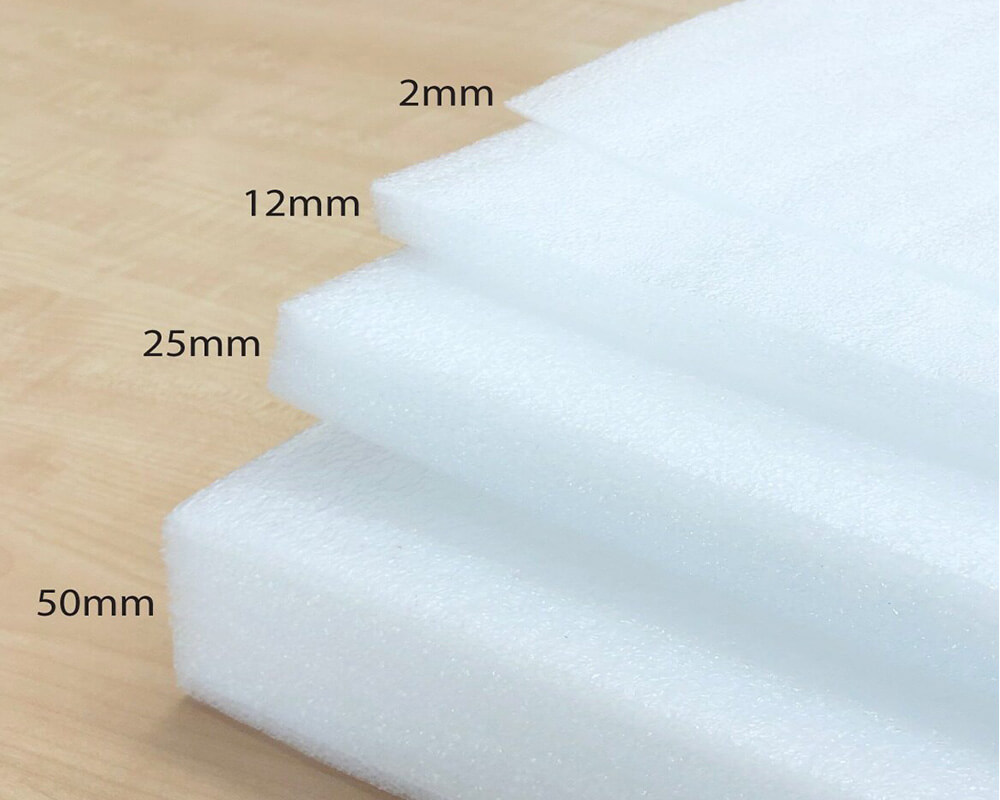
How to Choose the Right Polyethylene (EPE) Foam Thickness for Your Packaging Needs
Selecting the correct packaging material is only one part of protecting a product. You must also choose the right foam thickness.
EPE foam that is too thin may not provide enough cushioning during handling and transportation. Foam that is unnecessarily thick may increase packaging size, material usage and delivery costs without providing meaningful additional value.
The ideal EPE foam thickness depends on factors such as:
- The weight of the product
- How fragile it is
- The distance it will travel
- The type of transportation involved
- The likelihood of dropping, impact or vibration
- The amount of space inside the packaging
- Whether the product has delicate edges or surfaces
This guide explains how to choose a suitable EPE foam thickness for packaging products such as electronics, furniture components, glassware, household appliances, machine parts and consumer goods.
What Is EPE Foam?
EPE means expanded polyethylene foam. It is a lightweight and flexible foam material commonly used for cushioning, wrapping, separating and protecting products.
EPE foam can help protect products against:
- Surface scratches
- Minor impact
- Vibration
- Pressure
- Moisture
- Movement inside a carton
- Contact between multiple products
Polyethylene foam is often used in protective packaging because it is lightweight, clean, non-abrasive and capable of cushioning products against repeated impacts. It can also be cut, shaped or layered to suit different packaging designs.
VitaVisco manufactures polyethylene foam sheets in widths of 1.1 metres, 1.4 metres and 1.8 metres. Standard thicknesses range from 4 mm to 12 mm, while other thicknesses can be produced on request.
Why EPE Foam Thickness Matters
Foam protects a product by compressing and absorbing part of the energy created when a package is dropped, hit or subjected to vibration.
The thickness must provide enough room for the foam to compress without becoming completely flattened. When the foam is too thin for the weight and fragility of a product, the item may push through the cushioning and experience a stronger impact.
However, thicker foam is not automatically better.
The performance of a foam cushion also depends on its density, load-bearing area, the weight of the product, expected drop height and the amount of shock the product can tolerate. Professional cushioning calculations often use tested cushion curves rather than thickness alone.
The goal is therefore not to select the thickest foam available. It is to choose the most appropriate thickness for the product and its distribution journey.
A Simple EPE Foam Thickness Guide
The following table provides a practical starting point for VitaVisco’s standard EPE foam thicknesses.
| EPE foam thickness | Suitable starting applications | Protection level |
| 4 mm | Surface wrapping, interleaving, scratch protection and lightweight products | Light |
| 5–6 mm | Small consumer products, plastic components, cosmetics, polished items and light accessories | Light to moderate |
| 8 mm | Small electronics, household items, furniture fittings, spare parts and products requiring additional cushioning | Moderate |
| 10 mm | Delicate products, heavier components, repeated handling and stronger edge or surface protection | Moderate to high |
| 12 mm | Heavier or more fragile products, appliance components, equipment parts and custom protective inserts | Higher |
| Custom or layered thickness | High-value equipment, precision instruments, irregular products and demanding transport conditions | Application-specific |
This table should be treated as a selection guide rather than a guaranteed technical specification. The final packaging design should be tested with the actual product, carton and expected transportation conditions.
When to Use 4 mm EPE Foam
A 4 mm EPE foam sheet is suitable when the primary requirement is light surface protection rather than heavy impact absorption.
It may be used for:
- Wrapping polished metal components
- Separating stacked products
- Protecting furniture surfaces
- Lining boxes
- Wrapping lightweight plastic products
- Preventing products from rubbing against one another
- Protecting items from minor scratches during storage
For example, a furniture manufacturer may place 4 mm foam between finished wooden panels to reduce scratching during movement.
A 4 mm sheet may not be sufficient as the only protective layer for heavy, highly fragile or high-value products. In those situations, it can be combined with thicker corner pads, inserts or additional layers.
When to Use 5–6 mm EPE Foam
A 5 mm or 6 mm foam sheet provides slightly more cushioning while remaining flexible enough for wrapping.
It may be suitable for:
- Cosmetic containers
- Lightweight bottles
- Small household products
- Picture frames
- Plastic accessories
- Decorative products
- Small automotive components
- Product dividers
- E-commerce parcels with relatively durable contents
This thickness range can be useful when the item needs more protection than a thin surface wrap but does not require a heavy custom insert.
Businesses shipping products through several handling points should still conduct a sample-pack test before adopting the thickness for large-scale orders.
When to Use 8 mm EPE Foam
An 8 mm sheet provides a stronger cushioning layer and may be appropriate for products with moderate fragility or weight.
Possible applications include:
- Small electronic devices
- Electronic accessories
- Light household appliances
- Furniture fittings
- Ceramic products with additional protection
- Replacement parts
- Tools
- Metal components
- Products with moderately sensitive surfaces
An 8 mm sheet may be used as:
- A complete product wrap
- A base or top pad
- A carton liner
- A divider between products
- Part of a fabricated insert
- Additional protection around vulnerable areas
When packaging electronics, businesses should also consider electrostatic-discharge risks. An appropriate anti-static packaging material may be necessary for sensitive components; ordinary foam thickness alone does not provide electrostatic protection.
When to Use 10 mm EPE Foam
A 10 mm EPE foam sheet may be suitable when greater cushioning, spacing or edge protection is required.
Common applications may include:
- Delicate household products
- Medium-weight machine components
- Automotive parts
- Appliance components
- Glass products used with additional protective packaging
- Products that will experience repeated loading and unloading
- Products transported over longer distances
- Custom-cut corner and edge protectors
A 10 mm layer can help create more separation between the product and the outer carton.
This is important because an item placed too close to the side of a box may receive a more direct impact when the carton is dropped or struck.
When to Use 12 mm EPE Foam
A 12 mm EPE foam sheet provides a thicker protective layer within VitaVisco’s standard range.
It may be considered for:
- Heavier components
- Fragile consumer products
- Industrial spare parts
- Appliances
- Equipment accessories
- Products with sharp or vulnerable edges
- Reusable packaging
- Custom-cut packaging inserts
- Items transported through demanding distribution environments
For highly fragile products, 12 mm foam may still need to be layered or combined with other protective components.
Commercial polyethylene foam packaging can be laminated into much thicker structures for high-performance applications, demonstrating that demanding products often require a complete engineered design rather than one thin sheet.
Seven Factors to Consider Before Choosing a Thickness
1. Product weight
A heavier product places more pressure on the foam.
If the foam is too thin or unsuitable for the load, it may compress excessively and stop cushioning the product effectively.
Do not assume that a small product only needs thin foam. A small metal machine part can weigh more than a much larger plastic item.
Record the actual product weight before selecting the foam.
2. Product fragility
Fragility describes how much impact a product can tolerate before it becomes damaged.
Products with low fragility include items such as:
- Flexible plastic parts
- Clothing
- Some rubber products
- Durable household accessories
More fragile products may include:
- Glassware
- Ceramics
- Electronics
- Precision instruments
- Products with delicate screens
- Products with thin protruding parts
The more fragile the product, the more carefully its cushioning system should be designed.
Fragility, product weight, foam thickness and expected drop height are normally considered together when engineering protective packaging.
3. Shipping distance and method
A product delivered directly across a city may experience fewer handling points than one transported between states, stored in several warehouses and passed through multiple delivery partners.
Consider whether the item will travel by:
- Motorcycle
- Delivery van
- Truck
- Sea freight
- Air freight
- Courier network
Longer and more complex journeys may expose a package to additional vibration, compression, stacking and impact.
The packaging should be selected for the complete delivery journey, not only for the moment it leaves the factory.
4. Expected handling conditions
Ask the following questions:
- Will the carton be loaded manually?
- Could it be dropped?
- Will other cartons be stacked on top?
- Will it experience constant vibration?
- Will it be repeatedly opened and closed?
- Is the packaging intended for one delivery or repeated use?
ASTM identifies drop, vibration, shock, compression and transport-package performance tests among the methods used to evaluate protective packaging systems.
A product travelling through rough conditions may require thicker foam, stronger positioning or a custom packaging design.
5. Product shape
Irregularly shaped products often need more than a simple flat foam sheet.
Pay close attention to:
- Sharp corners
- Protruding handles
- Uneven surfaces
- Screens
- Glass sections
- Connectors
- Switches
- Decorative finishes
- Fragile attachments
A product may require 4 mm surface wrapping across most of its body and thicker 10 mm or 12 mm protectors around vulnerable corners.
Using different thicknesses in one package can provide targeted protection without unnecessarily increasing the entire carton size.
6. Movement inside the carton
Even thick foam may fail to protect a product properly if the item can move freely inside the box.
The packaging should hold the product securely without placing damaging pressure on it.
After packing the item, gently shake the closed box. Consider redesigning the internal packaging when you can hear or feel significant movement.
EPE foam can be used for blocking, bracing, cushioning, spacing and creating custom inserts that keep products in position.
7. Packaging cost and carton size
Thicker foam occupies more space.
This may require:
- A larger carton
- More storage space
- Higher material usage
- Higher delivery costs
- Different pallet arrangements
Using too little foam can lead to damaged products, refunds and replacement costs. Using more material than necessary can also reduce profitability.
The right design should balance product protection, material usage, carton size and transportation cost.
Do Not Focus on Thickness Alone
Two EPE foam sheets with the same thickness may not perform identically if they have different densities or physical properties.
A complete packaging decision should consider:
- Thickness
- Density
- Firmness
- Compression behaviour
- Recovery after impact
- Product weight
- Contact area
- Fragility
- Drop height
- Number of expected impacts
- Temperature and storage conditions
This is why a packaging supplier should understand the product and its distribution environment before recommending a final solution.
Can EPE Foam Be Layered?
Yes. Layers of polyethylene foam can be combined to create thicker cushioning structures and custom packaging components.
Layering may be helpful when:
- A standard sheet is not thick enough
- Different protection levels are needed in one package
- A custom insert must be created
- The product has an irregular shape
- Strong corner or edge protection is required
- The packaging will be reused
- A prototype is being developed
Commercial packaging manufacturers use laminated polyethylene foam to produce customised thicknesses and fabricated inserts for automotive parts, electronics, industrial equipment and other demanding applications.
VitaVisco can also produce custom EPE foam thicknesses on demand.
How to Test Your Packaging Before Ordering in Bulk
Before purchasing a large quantity of EPE foam, create a complete packaging sample.
Step 1: Pack the actual product
Use the intended:
- EPE foam thickness
- Carton
- Tape
- Dividers
- Corner protectors
- Wrapping method
Testing only the foam without the complete package may not reveal how the final packaging will perform.
Step 2: Check product movement
Close the carton and gently move it.
The product should remain securely positioned without excessive pressure on delicate areas.
Step 3: Simulate normal handling
Subject the sample to the type of handling it is likely to experience.
This may include:
- Carrying
- Stacking
- Vehicle vibration
- Repeated loading
- Controlled low-height drops
Avoid conducting unsafe or uncontrolled tests.
Step 4: Inspect the product and packaging
After the test, check for:
- Scratches
- Cracks
- Dents
- Loose components
- Compressed foam
- Damaged corners
- Carton deformation
- Product movement
Step 5: Improve the design
Increase, reduce or reposition the foam based on the findings.
For valuable, fragile or regulated products, use qualified packaging professionals and recognised laboratory testing procedures. Standards exist for evaluating cushioning characteristics, product fragility, drop performance, vibration and complete transport packaging systems.
Common EPE Foam Thickness Mistakes
Choosing based only on product size
A large lightweight product may require less cushioning than a small but heavy or fragile product.
Always consider weight and fragility.
Using thin foam for every product
A single thin sheet may protect a surface from scratches but may not absorb serious impact.
Separate surface protection from cushioning requirements.
Believing thicker foam solves every problem
An item can still be damaged inside thick foam when it moves freely, has unsupported components or is packed in a weak carton.
Thickness is only one part of the packaging system.
Ignoring corners and edges
Corners often receive direct impact when a carton is dropped.
Use additional corner and edge protection where necessary.
Failing to test the final package
A packaging design that looks effective may perform differently during transportation.
Test the completed package before adopting it for regular production.
Leaving too much empty space
Empty space allows the product to accelerate before hitting the side of the box.
Use suitable inserts, fillers or braces to control movement.
Compressing the foam before shipment
Foam needs enough space to compress during an impact.
When it is already heavily compressed inside the carton, its cushioning performance may be reduced.
Which VitaVisco EPE Foam Thickness Should You Choose?
Use this quick guide as a starting point:
- Choose 4 mm for wrapping, separation and basic surface protection.
- Choose 5–6 mm for lightweight products that need light cushioning.
- Choose 8 mm for moderate cushioning and additional impact protection.
- Choose 10 mm for delicate or medium-weight items requiring stronger protection.
- Choose 12 mm for heavier, more fragile or demanding packaging applications.
- Request a custom or layered solution for high-value, irregular, precision or highly fragile products.
The final selection should always reflect the actual product, carton and delivery conditions.
Order VitaVisco EPE Foam Sheets
VitaVisco manufactures polyethylene foam sheets for packaging, cushioning, insulation and industrial applications.
Available sheet widths include:
- 1.1 metres
- 1.4 metres
- 1.8 metres
Standard thicknesses range from 4 mm to 12 mm, while custom thicknesses can be produced according to project requirements.
Whether you are packaging electronics, furniture components, appliances, industrial parts or consumer products, VitaVisco can help you identify an appropriate foam solution.
Do not leave product protection to guesswork. Speak with VitaVisco about the product, weight, dimensions, quantity and transportation conditions before placing your order.
Are You a Manufacturer, Distributor or Packaging Supplier?
Contact VitaVisco for bulk EPE foam orders, custom thicknesses and packaging enquiries.
Protect your products, reduce avoidable damage and deliver them with greater confidence.